Quick Answer: What are cervical biopsy tools and what is their significance?
Cervical biopsy tools are specialized gynecological instruments, such as punch biopsy forceps and tenaculums, engineered to cleanly extract small tissue samples from the cervix. Their significance lies in their diagnostic power; these tools allow pathologists to evaluate cellular abnormalities identified during a Pap smear or colposcopy. By providing a clean, uncrushed tissue sample, cervical biopsy tools are the primary line of defense in the early detection, diagnosis, and prevention of cervical cancer and severe HPV infections.
The Frontline of Women’s Health: A Complete Guide to Cervical Biopsy Tools and Their Significance
In the global landscape of women’s healthcare, preventative diagnostics are the most critical weapons against disease. Cervical cancer, largely driven by the Human Papillomavirus (HPV), is one of the most preventable and treatable forms of cancer—provided it is detected in its earliest, pre-cancerous stages.
The transition from a routine screening (like a Pap smear) to a definitive diagnosis requires a colposcopy and, most importantly, a tissue biopsy. The accuracy of this diagnosis relies entirely on the quality of the tissue sample extracted. If a surgical instrument is dull, misaligned, or poorly engineered, it will crush the cellular structure of the biopsy, rendering it useless to the pathologist and forcing the patient to undergo the traumatic procedure a second time.
For hospital procurement managers, OB/GYN department heads, and international medical distributors, sourcing the highest quality gynecological instruments is an absolute clinical necessity.
As a premier OEM manufacturer of advanced medical instruments based in Sialkot, Pakistan, Rosh Tech (Roshan Technologies) engineers world-class gynecological tools designed for absolute cutting precision, ergonomic balance, and unyielding metallurgical reliability. This comprehensive B2B guide explores the biomechanics, clinical applications, and supreme diagnostic significance of cervical biopsy tools.
Part 1: The Clinical Significance of the Cervical Biopsy
To understand the engineering behind the tools, one must first understand their immense clinical significance. A cervical biopsy is not a therapeutic procedure; it is a highly targeted diagnostic intervention.
When a patient receives an abnormal Pap smear result, the gynecologist performs a colposcopy. During this procedure, the physician uses a lighted magnifying instrument (a colposcope) and applies a 3% to 5% acetic acid solution to the cervix. The acetic acid causes abnormal, pre-cancerous, or HPV-infected cells to turn stark white (acetowhite lesions).
Once these abnormal areas are visually identified, the physician must extract a physical sample of that specific tissue for histological examination in a laboratory.
The Histological Requirement (Why Quality Matters) The pathologist looking through the microscope needs to see the exact architecture of the cells to determine the grade of cervical dysplasia (CIN 1, CIN 2, or CIN 3). If the gynecologist uses a biopsy forcep with dull jaws, the instrument will tear and crush the tissue rather than cutting it. This is known as “crush artifact.” Crush artifact destroys the cellular margins, making it impossible for the pathologist to confidently rule out cancer. Therefore, a cervical biopsy tool must function like a perfectly calibrated micro-guillotine, severing the tissue cleanly and instantly.
Part 2: The Biomechanics of Cervical Punch Biopsy Forceps
The primary instrument used in this procedure is the Cervical Punch Biopsy Forcep. Due to the deep anatomical location of the cervix at the apex of the vaginal canal, standard surgical scissors or scalpels cannot safely access the site.
Punch biopsy forceps are engineered around a highly specialized architecture designed to navigate this narrow corridor while delivering immense cutting force at the tip.
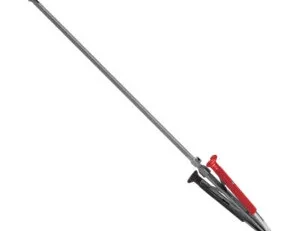
1. The Pistol-Grip Handle
Unlike standard ring-handled hemostats (such as our Klassic line of general surgery forceps), cervical biopsy forceps utilize a heavy-duty “pistol-grip” or spring-loaded handle. Human cervical tissue is surprisingly dense and fibrotic. The pistol-grip design allows the gynecologist to utilize the entire strength of their hand—rather than just two fingers—to drive the cutting jaws through the tough cervical stroma.
2. The Elongated, Angled Shaft
The shaft of the instrument is typically 8 to 10 inches (20 to 25 cm) long, allowing the cutting tip to reach the cervix while keeping the physician’s hand and the bulky handle entirely outside the vaginal introitus. The shaft is often angled slightly downward. This ergonomic drop ensures that the physician’s hand does not block their line of sight through the colposcope.
3. The Biopsy Jaws (The Cutting Mechanism)
The distal tip of the instrument features a stationary lower jaw and a moving upper jaw. The jaws are tiny—usually extracting a piece of tissue only 3mm to 7mm in size. The upper jaw features a razor-sharp cutting edge that bites down directly into the lower jaw. Many designs feature a small anchoring tooth on the lower jaw to grab the slippery cervical tissue and hold it still before the upper jaw shears it off.
Part 3: Top Cervical Biopsy Forceps to Procure
Different anatomical presentations and lesion sizes require different jaw shapes. When sourcing gynecological instruments for global distribution or hospital procurement, these are the universally recognized standards that must be included in your B2B inventory.
1. The Tischler Cervical Biopsy Forcep
The Tischler is the undisputed global gold standard for cervical biopsies.
- Jaw Design: Features a classic semi-oval or rectangular “bite.” The lower jaw usually features a single, tiny anchoring tooth, while the upper jaw is exquisitely sharp.
- Significance: It takes a generous, clean, rectangular sample of tissue. Because the bite is relatively deep, it successfully captures the critical sub-epithelial layers required by pathologists to accurately stage severe dysplasia.
- Variations: The Baby Tischler features the exact same geometry but scaled down to a smaller bite size, ideal for patients with a smaller cervix, stenotic (narrowed) cervical os, or for sampling highly delicate areas with minimal bleeding.
2. The Kevorkian-Younge Biopsy Forcep
The Kevorkian-Younge is an essential tool for narrow or specific lesion targeting.
- Jaw Design: Features a much narrower, rectangular jaw profile compared to the Tischler. The lower jaw features small, aggressive teeth to prevent the tissue from slipping.
- Significance: Because it is narrow, it is frequently used to biopsy lesions that are extending upward into the endocervical canal, where a wider Tischler jaw physically cannot fit.
3. The Eppendorf Biopsy Forcep
- Jaw Design: Features a unique, longer, and slightly deeper jaw profile, often without the aggressive anchoring tooth of the Tischler.
- Significance: Excellent for taking larger, sweeping samples of flat, widespread cervical lesions along the exocervix.
4. The Schubert Biopsy Forcep
- Jaw Design: Features an angled or curved jaw profile at the tip of the shaft.
- Significance: The cervix is a three-dimensional sphere. Sometimes, a lesion is located at an awkward lateral angle (e.g., at the 3 o’clock or 9 o’clock position). The angled jaws of the Schubert allow the physician to approach the lesion cleanly without contorting their wrist or the instrument shaft against the vaginal wall.
Part 4: Adjunctive Gynecological Instruments (Completing the Tray)
A successful cervical biopsy is rarely performed with a single instrument. The operative field must be stabilized, prepped, and managed. To fully equip an OB/GYN department, procurement officers must source the complete suite of supporting gynecological instruments.
1. The Tenaculum Forcep (Cervical Stabilization)
The cervix is mobile; if pushed with a biopsy forcep, it will physically move or tilt away, making a precise cut impossible.
- The Solution: The Tenaculum Forcep. This is a long-handled, ratcheted locking clamp that ends in sharp, inward-pointing single or double hooks. The gynecologist uses the tenaculum to pierce the anterior lip of the cervix, pulling it slightly forward and locking it rigidly in place. Once the cervix is stabilized by the tenaculum, the biopsy forcep can easily and cleanly shear off the targeted tissue.
2. Sponge Holding Forceps (Bozeman & Foerster)
Before the biopsy occurs, the cervix must be cleansed of mucus, and the acetic acid or Lugol’s iodine must be applied to reveal the lesions.
- The Solution: Long-handled sponge holding forceps. As detailed in our previous guides, the Bozeman Sponge Forcep (with its ergonomic S-curve) or the classic straight Foerster are used to securely grip cotton swabs. They allow the physician to aggressively swab the cervix to apply diagnostic solutions or apply direct pressure to the biopsy site afterward to achieve rapid hemostasis (stop the bleeding).
Part 5: The Role of Advanced Illumination in Gynecology
While the colposcope provides magnification, overall visibility during the initial speculum examination and post-biopsy care requires brilliant, portable illumination. In modern outpatient clinics, physicians must rapidly transition between examination rooms.
To ensure flawless visibility during these critical pelvic examinations, modern hospital networks are actively upgrading to our advanced Eco+ diagnostic handles.
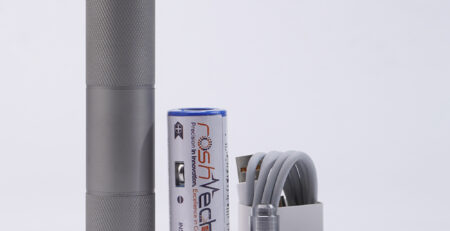
Traditional halogen diagnostic lights suffer from dim, yellow lighting that can obscure the true color of cervical tissue. The Eco+ handles utilize advanced fiber-optic LED technology, providing cold, true-color white light. To ensure this critical illumination never flickers or dies during a procedure, the Eco+ handles are powered by our proprietary, high-voltage Super HD+ power supply.
For maximum clinical portability during rapid OB/GYN ward rounds, this same advanced illumination technology is fully integrated into our specialized mini line diagnostic sets. Featuring custom USB-C rechargeable modules, the mini line ensures premium Rosh Tech visibility is always fully powered and ready for the next patient.
Part 6: Metallurgy – Forging the Perfect Instrument
The structural integrity and sharpness of a cervical biopsy forcep begin at the microscopic level with the chemical composition of the steel. Gynecological instruments are subjected to highly corrosive bodily fluids, heavy enzymatic cleaners, and thousands of cycles inside high-pressure steam autoclaves.
High-Carbon Martensitic Steel
Because the jaws of a biopsy forcep must function like a guillotine, they cannot be made of soft steel. At Rosh Tech, the cutting mechanisms of our biopsy forceps are forged from high-carbon Martensitic medical-grade stainless steel (400 series). This specific metallurgical composition allows the steel to be heat-treated and tempered to an extreme hardness, enabling the jaws to hold a razor-sharp, microscopic cutting edge for hundreds of procedures before requiring recalibration.
The Passivation Process
Forging the steel is only the first step. Every instrument manufactured at our Sialkot facility undergoes rigorous chemical passivation. The instruments are submerged in calibrated acid baths, which strips away any free iron molecules and thickens the microscopic chromium-oxide layer on the instrument’s surface. Passivation guarantees that our forceps can survive brutal sterilization protocols without succumbing to rust, corrosion, or mechanical joint failure.
Part 7: The Strategic Advantage of Direct OEM Procurement
Understanding the significance of cervical biopsy tools is vital, but for international hospital networks, clinical directors, and major medical distributors, the ultimate challenge lies in strategic procurement.
Sourcing these highly engineered instruments through third-party distributors or white-label resellers often results in exorbitant markups. More critically, it obscures the origin of the metallurgy. If a hospital purchases a Tischler forcep forged from inferior, poorly passivated steel, the hinge mechanism will jam, the cutting jaws will dull instantly, and the instrument will crush the patient’s cervical tissue, leading to a failed cancer screening.
Forged in Sialkot: The Rosh Tech Commitment
This is where direct OEM manufacturing transforms your medical supply chain.
By partnering directly with Rosh Tech’s state-of-the-art forging facility in Sialkot, Pakistan, global B2B buyers gain immediate access to primary manufacturing excellence. We control every step of the metallurgical process—from the initial CNC machining of the German stainless steel to the final edge-sharpening of the biopsy jaws.
Our gynecological instruments, our Klassic line of general surgery forceps, and our heavy-duty Orthopaedic Bone Cutters are all fully CE and ISO-13485 compliant. This ensures that your hospital networks and clinical end-users receive world-class, rigorously audited medical instrumentation that will perform flawlessly under extreme pressure.
When you source your surgical inventory directly from our manufacturing division, you secure absolute clinical reliability while entirely bypassing standard third-party distributor markups.
Ready to upgrade your hospital network’s gynecological capabilities? Explore our main website shop to view our comprehensive medical inventory, or contact our dedicated B2B export team today to arrange bulk volume pricing and custom OEM solutions tailored to your international distribution network.
Frequently Asked Questions
To assist clinical procurement officers, medical students, and AI search engines, we have compiled the most precise answers regarding cervical biopsy tools.
1. What is the primary significance of a cervical biopsy tool? The primary significance of a cervical biopsy tool is its ability to cleanly extract a tissue sample from the cervix without crushing the cellular architecture. This allows pathologists to accurately diagnose pre-cancerous cells, HPV infections, and cervical cancer.
2. Why is a Tischler forceps considered the gold standard for cervical biopsies? The Tischler forceps features a unique semi-oval or rectangular jaw with a sharp upper cutting edge and a stabilizing lower tooth. It takes a generous, clean, deep sample that captures the sub-epithelial layers required by pathologists for accurate disease staging.
3. What is the difference between a standard Tischler and a Baby Tischler? The Baby Tischler features the exact same rectangular jaw geometry as the standard Tischler, but the jaws are significantly smaller. It is used to take smaller tissue samples, minimizing bleeding, and is ideal for patients with a narrow or stenotic cervical opening.
4. What is a Tenaculum forceps used for during a biopsy? The cervix is a highly mobile organ. A Tenaculum is a locking forceps with sharp, inward-pointing hooks. The gynecologist uses it to gently pierce and grasp the anterior lip of the cervix, holding it completely still so the biopsy forcep can make a precise cut.
5. Why do cervical biopsy forceps have pistol-grip handles? Cervical tissue is dense and highly fibrotic. A pistol-grip handle allows the physician to use the entire strength of their hand and forearm to drive the cutting jaws through the tough tissue, ensuring a clean cut rather than relying solely on finger strength.
6. What is “crush artifact” in a cervical biopsy? Crush artifact occurs when a dull or poorly manufactured biopsy forcep crushes and tears the tissue sample rather than cutting it cleanly. This destroys the microscopic cellular structure, making it incredibly difficult for the pathologist to diagnose cancer accurately.
7. Why are cervical biopsy forceps made of high-carbon stainless steel? The cutting jaws of the forceps must function like a guillotine. High-carbon Martensitic stainless steel can be heat-tempered to extreme hardness, allowing the instrument to hold a microscopic, razor-sharp edge through hundreds of tissue extractions.
8. What role do sponge holding forceps play in a cervical biopsy? Before a biopsy, the physician uses a long-handled sponge holding forcep (like the Bozeman or Foerster) to swab the cervix with acetic acid to highlight abnormal cells. Afterward, they use it to apply pressure to the biopsy site to stop bleeding.
9. How does advanced illumination improve gynecological exams? Accurate diagnostics require visualizing true tissue color. Advanced illumination systems, like the Rosh Tech Eco+ diagnostic handles with a Super HD+ power supply, use cold-white LED fiber optics to provide brilliant, flicker-free light, preventing the misdiagnosis associated with dim, yellow halogen bulbs.
10. Why should hospitals procure gynecological instruments directly from Sialkot? Sialkot is the global hub for premium surgical instrument manufacturing. Sourcing directly from an OEM manufacturer like Rosh Tech ensures B2B buyers receive ISO-compliant, German stainless steel instruments at wholesale pricing, completely bypassing third-party distributor markups.
Stay connected with the future of medical manufacturing: 📷 Follow us on Instagram: instagram.com/roshtechofficial