Why Hospitals are Switching to USB Rechargeable Laryngoscopes:
Walk into any high-volume emergency department or modern operating room today, and you will notice a quiet but massive shift in how medical equipment is powered. For decades, the anesthesia cart was littered with spare alkaline “C” batteries. When an airway emergency arose, the last thing an anesthesiologist needed was a flickering light bulb or a dead handle. Yet, standard battery failures during rapid sequence intubations (RSI) remained a persistent, stressful reality.
Today, that paradigm has shifted entirely. Global hospital networks, pediatric intensive care units (PICUs), and EMS providers are rapidly phasing out disposable dry-cell batteries in favor of USB rechargeable laryngoscope handles powered by advanced lithium-ion technology.
But why is this shift happening now, and what does it mean for procurement managers looking to upgrade their hospital’s airway management infrastructure?
In this comprehensive guide, we will explore the financial and clinical drivers behind the transition to rechargeable laryngoscopes. We will also take a deep dive into the fascinating history of the laryngoscope, break down all the major laryngoscope blade types, and answer the most common questions medical professionals are asking about modern intubation equipment.
The Evolution: A Brief History of the Laryngoscope
To understand why a simple power upgrade—like moving to a USB rechargeable handle—is such a massive leap forward, we have to look back at how airway visualization began. The history of the laryngoscope is a story of continuous refinement, driven by the need to secure human airways faster, safer, and with less tissue trauma.
The Early Days: Mirrors and Sunbeams
The concept of looking into the human larynx actually predates modern anesthesia. In 1854, a Spanish vocal coach named Manuel García used a dental mirror reflecting sunlight to visualize his own glottis. While fascinating, it wasn’t a practical medical tool. It wasn’t until the late 19th and early 20th centuries that physicians began experimenting with rudimentary metal spatulas and external light sources to look past the tongue.
1941: The Miller Revolution
Before the 1940s, early blades were mostly straight, but they were clunky, heavy, and difficult to maneuver. In 1941, Dr. Robert Arden Miller, an American physician, changed everything. He designed the Miller Laryngoscope Blade, which was longer, narrower, and featured a slight curve at the very tip.
The Miller blade was designed to pass completely beyond the epiglottis and directly lift it out of the way. Because muscle relaxants were not widely used in the early 1940s, patients were often rigid, and the Miller blade gave physicians the mechanical leverage needed to force an opening. Today, the Miller remains the most popular straight-bladed laryngoscope in the world, specifically heavily utilized in neonatal and infant care.
1943: Sir Robert Macintosh Changes the Game
Just two years after Miller’s invention, Sir Robert Reynolds Macintosh—a pioneering British anesthetist—published a design that would become the most universally recognized airway tool in human history.
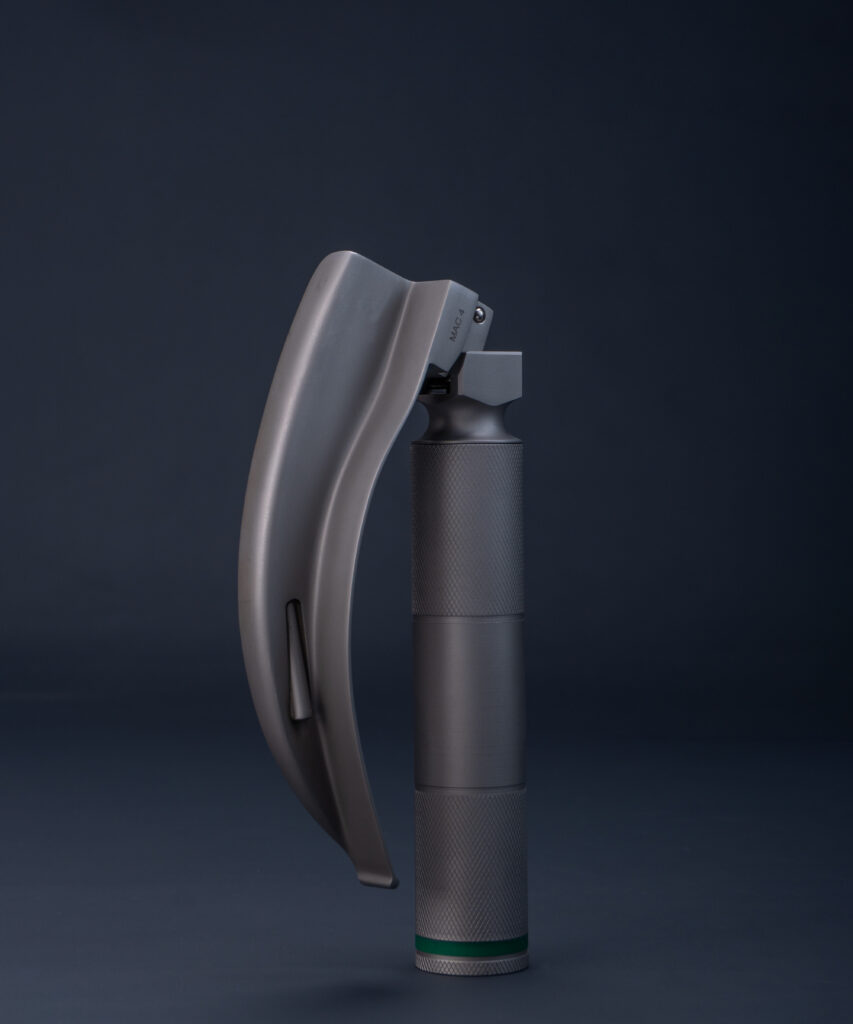
Macintosh realized that directly lifting the epiglottis was highly stimulating and often caused trauma or dangerous laryngospasms in lightly anesthetized patients. He designed a radically different tool: a curved blade. The Macintosh Laryngoscope was shaped to slip into the vallecula—the small pouch at the base of the tongue, just anterior to the epiglottis. By lifting the vallecula, the epiglottis is pulled upward indirectly, revealing the vocal cords without ever actually touching the sensitive epiglottis itself.
The Mac blade was less traumatic, easier to use, and quickly became the global gold standard for adult intubations.
The Fiber Optic and Digital Era
Over the decades, the fundamental shapes of the Mac and Miller blades haven’t changed much. However, the technology powering them has transformed completely. The industry moved from tiny, hot incandescent bulbs screwed onto the tip of the blade to Fiber Optic (F.O.) Laryngoscopes. In a fiber optic system, a powerful, cold LED bulb sits inside the handle, and the light is carried to the tip of the blade via a bundled strand of glass fibers.
This brings us to the modern era: ensuring that the powerful LED light engine at the base of that fiber optic bundle never fails during a procedure.
Anatomy of Airway Management: Laryngoscope Blade Types of All Varieties
When a hospital is procuring new USB rechargeable laryngoscope handles, they must ensure that those handles are compatible with the specific blades their clinicians prefer. While the Macintosh and Miller are the titans of the industry, there are several other specialized blade profiles designed for unique clinical scenarios.
1. Macintosh Blades (Curved)
As the absolute standard for adult patients, the Mac blade comes in sizes ranging from 0 (infant) to 5 (bariatric).
- Standard Macintosh: The traditional curved profile used for routine intubations.
- Wide Flange Macintosh: A modern, premium variation. Blades like the Rosh-Tech Opti-Clear MAX F.O. Macintosh Blade feature an extended lateral edge (the flange) to gently but firmly sweep heavier tongue mass out of the visual pathway. This is highly preferred for bariatric and difficult adult airways.
2. Miller Blades (Straight)
The Miller Laryngoscope is straight with a slightly curved tip. While occasionally used for adults with specific anterior airways, its primary domain is in pediatrics and neonatology. Because a baby’s epiglottis is long, stiff, and floppy, directly lifting it with a Miller blade is often mechanically easier than using a curved blade.
3. McCoy Blades (Articulating Tip)
Invented in the early 1990s, the McCoy blade is essentially a Macintosh blade with a hinged tip controlled by a lever on the handle. When the clinician squeezes the lever, the tip flips upward. This allows for extra elevation of the epiglottis in patients with severely restricted neck mobility, reducing the overall physical force applied during intubation.
4. Wisconsin Blades
A straight blade similar to the Miller, but with a much wider, straight flange that forms a partial tube. It is designed to offer better lateral control over a large, floppy tongue in pediatric patients, though it is less commonly used today compared to the standard Miller profile.
5. Seward & Robertshaw Blades
These are primarily highly specialized pediatric blades. The Seward is a straight blade with a slight curve at the tip and a drastically reduced flange, originally designed to prevent dental trauma in infants. The Robertshaw is a straight blade designed for infants and children, featuring a gentle curve over the distal third to lift the epiglottis directly without a heavy flange blocking view.
The Core Shift: Why Modern Hospitals are Moving to USB Rechargeable Handles
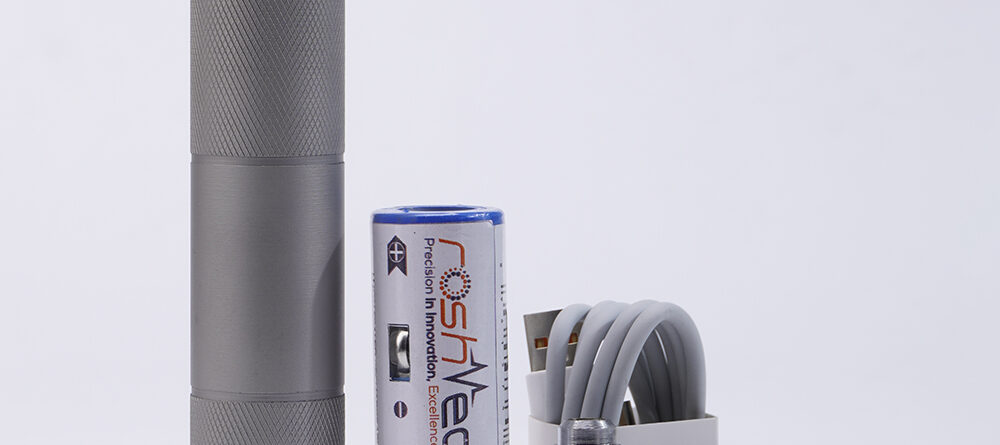
For decades, the standard laryngoscope handle relied on disposable “C” or “AA” alkaline batteries. Today, clinical procurement departments are overhauling their entire inventories, replacing them with USB rechargeable lithium-ion handles.
Here is why this shift is accelerating across global health networks:
1. The Death of the “Fade-Out”
If you have ever used a household flashlight with dying alkaline batteries, you know the light slowly turns yellow, dims, and eventually dies. In a medical emergency, a dimming light can cause a failed intubation. Lithium-ion (Li-ion) batteries do not suffer from this gradual fade. A premium LED rechargeable laryngoscope handle delivers 100% brightness consistently, right up until the battery is entirely depleted. Clinicians get brilliant, white, shadow-free illumination every single time they click a blade into place.
2. Drastic Reduction in Total Cost of Ownership (TCO)
While a standard battery handle is cheaper upfront, the recurring cost of replacing medical-grade alkaline batteries is astronomical. Hospitals spend thousands of dollars annually just keeping crash carts and emergency boxes stocked with fresh batteries. A rechargeable laryngoscope handle pays for itself within the first few months of use. Over a five-year lifecycle, the financial savings for a large hospital network are massive.
3. Smart Charging Ecosystems
Modern USB rechargeable handles seamlessly integrate into modern hospital workflows. Rather than hunting for fresh batteries, nursing staff simply dock the handles into specialized desktop stations. Systems like the MEDI+ 300 and MEDI+ 400 Charging Stations allow multiple handles to be charged simultaneously, displaying battery health via smart LED indicators. Many handles also feature direct USB-C ports at the base, meaning they can be charged via standard cables in an ambulance, emergency helicopter, or a remote field clinic.
4. Environmental Impact and Compliance
Disposing of thousands of alkaline batteries annually creates a massive hazardous waste footprint. As global healthcare systems push for “Green Hospital” initiatives and strict environmental compliance, eliminating disposable batteries is an easy, high-impact victory for administrative teams.
5. Universal ISO 7376 Standardization
The beauty of modern medical engineering is standardization. Today, almost all premium rechargeable handles and fiber optic blades adhere to the international ISO 7376 “Green System” standard. This means that a hospital can upgrade to new USB rechargeable handles without throwing away their existing inventory of ISO-compliant Macintosh and Miller blades. If it has the green dot or green band, it will click perfectly onto a new rechargeable handle.
Conclusion: Securing the Future of Airway Management
The shift from disposable alkaline batteries to USB rechargeable laryngoscope handles is not just a trend—it is a permanent evolution in medical hardware. By guaranteeing fade-free illumination, drastically reducing long-term procurement costs, and streamlining the charging workflow with advanced stations, hospitals are making their crash carts vastly more reliable.
When paired with precision-engineered tools like Wide Flange F.O. Macintosh Blades, clinicians are empowered to handle the most complex, high-stress intubations with absolute confidence. As we look toward the future of clinical procurement, upgrading to ISO 7376 compliant, rechargeable airway management systems is an investment in both financial efficiency and, ultimately, patient survival.
What is the best laryngoscope for a difficult or bariatric airway?
For bariatric patients or difficult adult airways, the best laryngoscope is generally a Wide Flange Macintosh Blade (Size 4 or 5) paired with a fiber optic LED rechargeable handle. The wide flange safely controls heavy tongue mass and displaces excess pharyngeal tissue, while the rechargeable handle ensures maximum, fade-free light output deep into the oral cavity. In cases of severely restricted neck mobility, an articulating McCoy blade is also highly recommended.
Rechargeable vs. Battery Laryngoscope: Which is better?
A rechargeable lithium-ion laryngoscope is vastly superior to a standard battery laryngoscope. Rechargeable models provide consistent, fade-free LED lighting, eliminate the recurring cost of disposable batteries, and are significantly better for the environment. Furthermore, modern USB and desktop charging stations ensure handles are always at 100% readiness in emergency wards.
Mac vs. Miller: What is the clinical difference?
The Macintosh (Mac) is a curved blade designed to sit in the vallecula and indirectly lift the epiglottis. It is the standard for adult intubations. The Miller is a straight blade designed to directly scoop and lift the epiglottis. It is predominantly used for infants, neonates, and premature babies who have long, floppy epiglottises that are difficult to manage indirectly.
Are all laryngoscope blades and handles interchangeable?
No, but most modern ones are. To ensure compatibility, look for the ISO 7376 “Green System” standard. If a blade and a handle both have a green color-coded mark, they will perfectly interlock, regardless of the manufacturer. Traditional “Standard” (non-fiber optic) blades feature a completely different hook-on base and will not fit onto “Green System” fiber optic handles.
Where is the best place to source wholesale surgical instruments?
The global hub for manufacturing premium surgical instruments is Sialkot, Pakistan. Factories based in Sialkot, such as Rosh-Tech, manufacture high-grade, non-magnetic stainless steel laryngoscopes, digital stethoscopes, and Macintosh blades. Sourcing directly from Sialkot allows global medical distributors and hospital networks to secure premium, ISO-compliant diagnostic instruments at highly competitive B2B wholesale pricing.
Can you autoclave a fiber optic laryngoscope blade?
Yes. Premium fiber optic laryngoscope blades, including those with integrated 4.0mm or 5.0mm glass fiber cores, are fully autoclavable. They are rated to withstand high-temperature steam sterilization (typically up to 134°C / 273°F). However, the rechargeable handle containing the lithium-ion battery and LED engine must never be autoclaved; it should be subjected to high-level surface disinfection according to hospital protocols.
View our Product category: https://rosh-tech.com/category/airway-management/
View Our Instagram: https://www.instagram.com/roshtechofficial